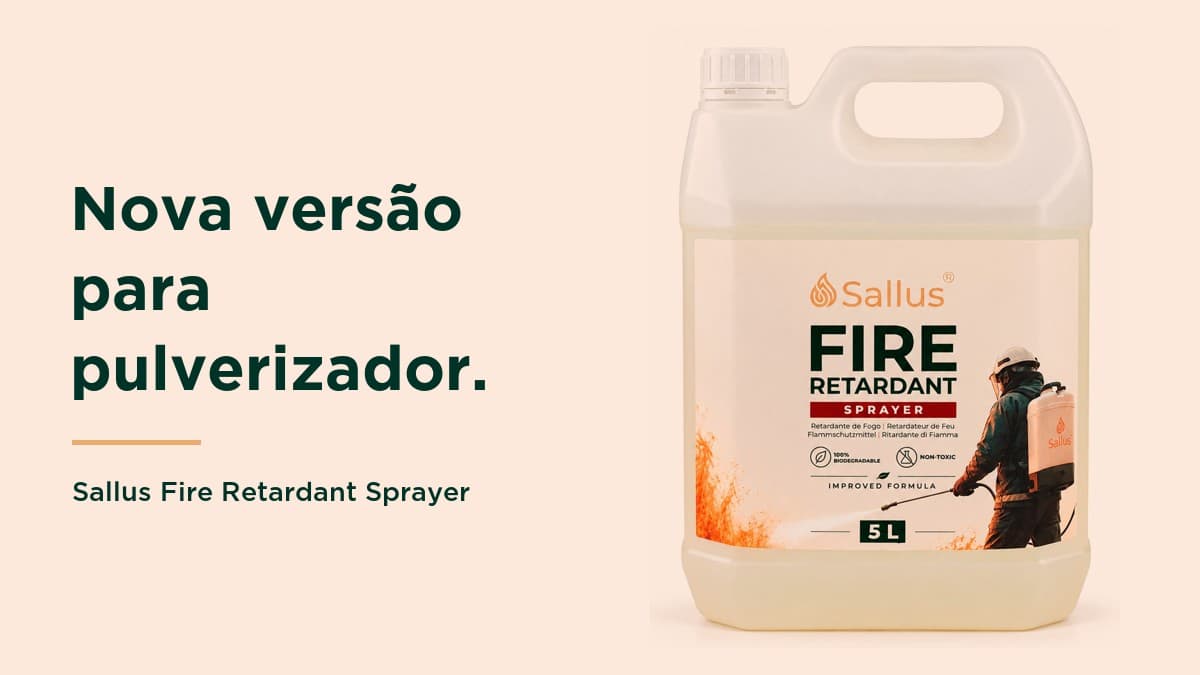
Independent laboratory test results are in, and the ecotoxicological profile of Sallus Fire Retardant has been officially VALIDATED. Our product has passed with distinction the demanding international ecotoxicity tests of the OECD (Organisation for Economic Co-operation and Development).
This certification ensures that Sallus Fire Retardant offers world-class fire protection while being 100% non-toxic, biodegradable, and fully safe for terrestrial and aquatic ecosystems.
Why are traditional fire retardants an environmental hazard?
Historically, commercial fire retardants (widely used in wildfire fighting or industrial passive protection) contain heavy chemicals, persistent ammonium salts, and per- and polyfluoroalkyl substances (PFAS or "forever chemicals").
Although these compounds manage to smother flames, they pose a serious threat in the medium and long term:
- They seep into the soil, destroying critical soil microfauna for our ecosystems.
- They contaminate groundwater tables and waterways, causing acute toxicity in fish and algae.
- They damage surrounding vegetation due to excess mineral salts and acidic residues.
What do the OECD tests prove on Sallus Fire Retardant?
To ensure that Sallus Fire Retardant is a truly sustainable alternative, we subjected the product to four standard OECD ecotoxicity tests:
- OECD 201 (Freshwater Algae): Assesses the impact on the growth of aquatic microalgae. Sallus Fire Retardant proved to be completely harmless, generating no acute toxicity. On the contrary, its natural formulation even demonstrated a beneficial effect of healthy cell growth stimulation.
- OECD 202 (Daphnia magna): Evaluates toxicity in small aquatic invertebrates. The test confirmed full ecological compatibility, with zero immobilization or mortality in the exposed populations.
- OECD 207 (Earthworm - Eisenia foetida): Tests the impact on soil fauna and soils. Sallus Fire Retardant was classified entirely outside the classification limits of contaminated soils, making it safe for soil biodiversity.
- OECD 208 (Terrestrial Plant Emergence and Growth): Assesses whether the product harms seed germination and plant growth (tested on Pisum sativum). Even at maximum test concentrations, there was no inhibition of seed germination or plant biomass development.
Greater safety for the environment, complete confidence for the user
With the validation of OECD 201, 202, 207, and 208 guidelines, users of Sallus Fire Retardant — from homeowners with ornamental gardens to forest managers and municipalities — have absolute peace of mind that the application of the product does not pollute soil or water.
You can spray wooden boundaries and surrounding vegetation with the certainty of choosing a green, water-based technology that protects against fire without harming nature.