
We have taken another decisive step in our commitment to sustainability. Sallus Fire Retardant has officially obtained the OECD 301B and OECD 301F certifications through independent laboratory testing following the gold standard international framework for evaluating the biodegradability of chemical substances.
The results could not be clearer: our formulation achieved 95.4% biodegradation after 28 days and earned the highest official classification: "Readily Biodegradable", the most demanding and rigorous tier of this methodology.
Why Choose a Biodegradable Fire Retardant?
Choosing a fire retardant is not merely a technical choice; it is also an environmental responsibility. Conventional products that persist in nature for years pose serious risks to ecosystems, soil health, and water resources.
With the validation of OECD 301B and OECD 301F and the "Readily Biodegradable" classification, we offer our customers:
- Regulatory confidence: full compliance with the most stringent international standards across the chemical and forestry sectors;
- Environmental responsibility: rapid and near-complete breakdown in natural environments;
- Transparency and rigor: results verified and audited through independent laboratory trials using globally recognized methodologies;
- Real differentiation: clear proof that high-performance fire protection does not need to compromise nature.
What Are the OECD 301B and OECD 301F Guidelines?
The OECD Guidelines for the Testing of Chemicals evaluate the ability of a substance to break down through microbial activity over a 28-day period.
We submitted Sallus Fire Retardant to both tests to ensure total rigor and transparency: passing a single criterion was not enough; we wanted to prove consistency across two complementary methodologies.
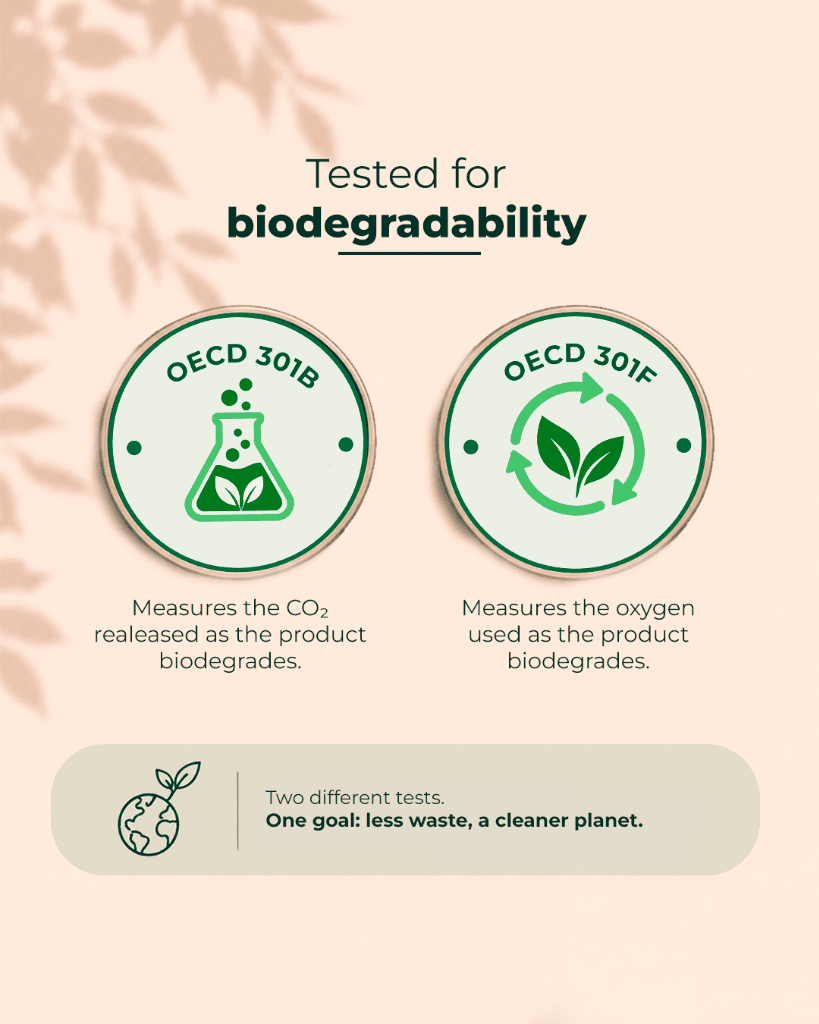
- OECD 301B (CO₂ Evolution): directly measures product mineralization by tracking the amount of carbon dioxide released by microorganisms as they consume and break down organic matter. Sallus Fire Retardant recorded 95.4% biodegradation by the end of the 28-day trial.
- OECD 301F (Manometric Respirometry): monitors oxygen consumption (O₂) during microbial metabolic degradation. The product reached 79.7% biodegradation, confirming active and sustained biological breakdown.
95% Biodegradation: A Result That Speaks for Itself
By reaching 95.4% biodegradation under the 301B method, Sallus Fire Retardant performs well above the 60% regulatory pass threshold mandated by these standards.
In practice, we can assert with scientific confidence that Sallus Fire Retardant is a solution with minimal ecological impact, breaking down safely and rapidly once its protective duty is complete.
"Readily Biodegradable": The Benchmark That Sets It Apart
This standard ensures not just that a substance breaks down eventually, but that it does so rapidly right from the initial stages.
To achieve the "Readily Biodegradable" designation, the product must cross the pass threshold within the "10-day window" (the 10-day period after biodegradation reaches the first 10%). While several formulations on the market are merely classified as generically "biodegradable" because they fail this rapid-response window, Sallus Fire Retardant comfortably met all criteria from day one.
Our Commitment to Sustainable Fire Protection
This independent certification proves that it is entirely possible to protect lives, structures, and forests without compromising our planet. At Hephaesnus, we continue to invest in dedicated research and development to deliver fire safety solutions that combine unyielding efficacy with genuine sustainability.